
Many people confuse M&A advisory with investment banking, but they actually focus on different aspects of business transactions. This article will explain how each operates and what sets them apart.
Key Takeaways
- M&A, which stands for mergers and acquisitions, deals with companies either merging or one acquiring another to enhance growth. This process includes identifying potential targets, conducting due diligence, negotiating terms, and integrating the companies post-deal.
- Investment banking supports businesses in raising capital through methods like issuing shares or securing loans. They are involved in significant transactions such as IPOs (initial public offerings) and provide guidance on investment strategies.
- The goal of M&A is to strengthen companies by uniting them or broadening their market presence, often saving time and resources compared to gradual growth.
- In investment banking, bankers serve as intermediaries between those seeking funds (like startups or large corporations) and investors looking for opportunities to grow their investments.
- Although both fields require extensive planning and financial expertise, M&A is primarily concerned with business combinations, while investment banking focuses on assisting companies in managing their finances through a variety of services.
Key Objectives of M&A
In M&A, companies aim to grow stronger and bigger. They do this by joining forces or buying other companies to get more market control, mix strengths together for better results, and reach new customers in different places.
Market position enhancement
Companies do M&A to get stronger in the market. They join with other companies or buy them. This makes them bigger and can help them face competition better. For example, two tech firms might merge.
This new big company can now make more products and reach more customers.
Strategic choices in M&A make a company’s place in the market better. They look at others to join with that can add value to what they already do. Think of a clothing brand buying a shoe company.
Now, they can offer full outfits, not just clothes or shoes alone. This move helps them stand out from others selling only one type of item.
Synergy achievement
Achieving synergies involves companies collaborating to enhance their operations beyond what they could accomplish independently. This objective figures prominently in M&A transactions, similar to the concept of yielding more than the sum of individual parts.
Firms search for avenues to blend their strengths, minimize expenses, and accelerate growth. This could involve sharing technology or consolidating teams for improved efficiency.
This strategy aids firms in generating increased value. For instance, a large corporation might acquire a smaller one possessing distinctive technological solutions. Collectively, they can provide new services or goods that were unattainable individually.
This illustrates the function of synergy in M&A transactions, focusing on rendering the amalgamated company more potent and valuable than its independent components.
Market reach expansion
After companies achieve synergy, they often look to grow their market reach. This means they want to sell their products or services to more people in new areas. M&A deals are a strong way for companies to do this quickly.
Instead of starting from zero in a new place, buying another business lets them jump right in.
For example, if a company wants to sell its products in Asia but doesn’t have stores there yet, it might buy an Asian company already doing well. This move can save time and money.
It helps the company reach new customers fast. M&A is key for businesses that want to grow this way.
Activities in M&A
In M&A, the focus is first on finding companies to join or buy. Then, teams work hard checking all the details of those businesses to make sure there are no surprises. They talk about terms and take care of putting everything together after the deal closes.
This involves a lot of planning and talking with different people to ensure the two companies blend well.
Identifying potential targets
M&A professionals work hard to find the right companies for acquisition. They look at many factors like how much a company is worth, its market position, and if it can help their client grow.
This step is key in mergers and acquisitions (M&A). For example, they might use business valuation tools to figure out if a target makes sense financially.
Investment bankers also play a big part in this process. They help clients find either companies to buy or interested buyers. Using market data and analysis, they match sellers with the right buyers.
They focus on making deals that benefit both sides by looking closely at prices, stock options, and financial health of companies involved in potential transactions.
Performing due diligence
Performing due diligence is an essential part of mergers and acquisitions. Investment bankers and other professionals carefully examine the specifics of a company they are considering for purchase or merger. They review financial statements, legal issues, and the overall operational efficiency of the business.
This helps them know if the deal is good or if there are risks.
They use tools like financial analysis to see how much money the company makes and spends. They also talk about debts and assets, which are things the company owns like buildings or cash.
Due diligence lets buyers make smart decisions before they agree to a deal. It’s important for making sure everything goes smoothly later on.
Negotiating deals
After looking closely at a company, it’s time to talk deals. M&A professionals sit down to discuss terms between buyers and sellers. They work hard to make sure both sides agree on the price and details of the sale.
This part is crucial for mergers & acquisitions (M&As) because it decides how much money changes hands and how the combined company will run in the future.
In this step, investment bankers also play a big role. They help by creating terms that benefit everyone involved in an M&A deal. Their goal is to reach an agreement that keeps liquidity flowing.
This means making sure money can move easily in these deals, which helps businesses grow or merge without major problems.
Overseeing post-transaction integration
After finalizing the agreement, M&A professionals plunge into the follow-up coordination of the transaction. This stage is dedicated to ensuring seamless workings when two companies unify.
It’s a substantial task with an objective to merge distinct sectors of the businesses to function as a single entity. This involves integrating cultures, systems, and teams targeting triumph.
M&A consultants contribute significantly in this phase. They outline strategies to merge operations and reduce redundancy, leading to cost-saving and improved performance universally.
Consider them as the guiding forces, directing both sides through alterations to ensure the newly formed entity achieves its goals promptly and more effectively.
Collaborating closely with leaders from both firms, these advisors concentrate on achieving synergy—where the collective outcome surpasses the mere sum of its components—and enlarging market presence by discovering new prospective ventures collectively.
Investment Banking Services
Investment banking provides a variety of services designed to assist companies in their growth and financial management. They are essential in areas such as securing funds for expansion, advising on significant transactions, and facilitating mergers and acquisitions. the process of going public more streamlined for businesses.
Capital raising
Banks help companies get money for their needs. They use debt and equity financing. This means they can give loans or sell parts of the business to investors. For new companies, banks play a big role in helping them go public through IPOs.
Going public lets anyone buy shares and invest in these businesses. This process gets a company lots of money to grow bigger, start new projects, or pay off old debts.
In this work, banks act like bridges between companies needing funds and people wanting to invest money. Whether it’s for a small startup or a huge corporation, they find the best way to get the required cash.
Banks look at what the company offers—products, services, future plans—and then decide how much money it might need. They also talk with potential investors about why putting money into these businesses is a good idea.
Underwriting securities
After raising capital, investment banks play a big role in underwriting securities. This means they guarantee the sale of stocks and bonds to investors. These banks check if these are safe for people to buy and sell them at a price that makes sense.
Investment bankers collaborate with companies to determine the appropriate pricing for their stocks or bonds. They then commit to selling all of these securities, assuming the risk if they are unable to sell at the intended price.
By doing this, companies get money they need without worrying about selling everything themselves.
Initial Public Offerings (IPOs)
Investment banks act as underwriters for IPOs, helping companies determine the offering price, structure the deal, and market the shares to potential investors. They provide valuable advice on timing, valuation, and investor sentiment, maximizing the chances of a successful IPO.
Investment banks also provide ancillary services related to IPOs, such as due diligence, regulatory compliance, and investor relations. They play a crucial role in navigating the complexities of the IPO process and ensuring regulatory compliance to meet listing requirements.
Corporate Finance
Investment bankers advise corporate clients on financial matters, including capital structure, financing options, and strategic initiatives such as mergers, acquisitions, and divestitures. They help companies optimize their capital allocation and achieve growth objectives through effective financial management.
Differences Between M&A and Investment Banking
M&A focuses on joining companies or buying and selling them. Investment banking helps companies raise money and deal with stocks.
Scope of activities
M&A (mergers and acquisitions) and investment banking are distinct areas. M&A is primarily concerned with the process of merging companies or facilitating their sale or purchase.
This includes finding companies to buy or merge with, checking them carefully before a deal, talking about the deal’s terms, and then making sure the two companies work well together after.
On the other hand, investment banking helps businesses get money through debt and equity financing, managing IPOs (when a company sells shares to the public for the first time), private placements (selling securities privately rather than on the public market), and restructuring if a company needs to change its financial setup.
Both fields use many tools like valuation techniques to figure out how much businesses are worth, market analysis for understanding where opportunities lie, and negotiation strategies to agree on good terms.
They also depend on networking within industries like commercial real estate, private equity firms that invest in companies looking to grow or change significantly but aren’t listed on stock exchanges yet as well as consulting analysts who study markets deeply from brokerage firms that help manage these deals.
Next up: let’s look at roles within these sectors.
Roles
M&A experts focus on making deals. They work out how much things are worth, set up the deal, and talk to get the best terms. They help when one company wants to buy another or merge with it. Or facilitate a sale of a company.
Their job is to make sure both sides agree on a fair price and understand what they’re getting into. This means looking at lots of numbers, talking a lot, and thinking about what could go wrong or right.
Investment bankers have different tasks. They find ways for companies to get money through sales or by finding investors. These bankers also look at a significant amount of data but use it to show companies how they can grow or start new projects with extra cash.
They play a big part in selling shares to the public or finding big investors who want to put their money into something they think will grow. So, while M&A pros focus on joining companies together, investment bankers make sure those companies have the money they need to do well in their plans.
In Summary: M&A Advisory vs Investment Banking
M&A and investment banking cover different areas of finance. An M&A broker firm looks at joining companies, selling, or buying them. Investment banking helps businesses raise money and manage big financial deals.
Both play key roles but focus on varied tasks. Understanding these differences helps people make smart choices in finance jobs and services.
Consult with ValleyBiggs Today
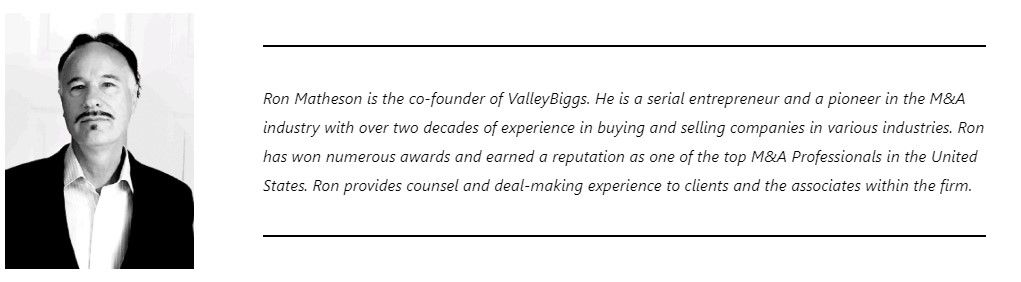
ValleyBiggs offers M&A Investment Banking, Sell-Side and Buy- Side M&A among other services. Ask for a free, no-commitment consultation. With over $2 billion in successful transactions and more than 20 years of award-winning experience, we provide a 100% success-based service with no upfront fees.

FAQs
1. What are the main differences between M&A advisory and investment banking?
M&A advisory primarily involves assisting companies with mergers, acquisitions, and sell-side negotiations. In contrast, investment banking is more focused on equity securities and managing investments for institutional clients.
2. Can you explain what M&A activity involves?
M&A activity revolves around merger and acquisition of businesses. It includes valuations of firms, dealing with organizational structures, negotiating deals…even handling hostile takeovers!
3. How does the role of a business broker fit into this picture?
Business brokers serve as intermediaries in mergers and acquisitions, assisting entrepreneurs in selling their businesses to potential buyers for a higher value.
4. Do family offices have any involvement in these sectors?
Absolutely! Family offices often engage in both–M&A consulting or using services from investment banks to manage their wealth.
5. Does an employee’s role change during an M&A process or when dealing with investment bankers?
Yes indeed! Employees may need to adapt to new roles or processes post-M&As…and sometimes they might even negotiate terms for equity crowdfunding as part of the deal.
6. How did the financial crisis impact these sectors?
The financial crisis brought about significant changes—there was increased scrutiny over accounting practices and stricter regulations were implemented for broker-dealers.